From January through September 2016, a team of NOAA and external partners will embark on a journey with NOAA Ship Okeanos Explorer to investigate and document deep-water environments in and around the Hawaiian Archipelago, the Commonwealth of the Northern Marianas Islands (CNMI) and the Marianas Trench Marine National Monument (MTMNM), and Wake Atoll section of the Pacific Remote Islands Marine National Monument (PRIMNM). A multidisciplinary team of scientists, technicians, and engineers – both on board the ship and on shore – will conduct undersea mapping and remotely operated vehicle (ROV) explorations of the geological, biological, archaeological, and chemical features of these vast areas.Stockton University Biology professor, Dr. Tara Luke is participating in the evaluation of data collected during these dives! You can follow her twitter feed here, and see the richness of diversity of life -- even at a few thousand meters below the ocean surface!!
Thursday, June 30, 2016
The Okeanos Explorer
Labels:
biodiversity,
marine biology,
marine organisms,
Stockton
Tuesday, August 11, 2015
Are We Wearing the Wrong Shoes?
Some people can find going to buy shoes bothersome, others not so much. Personally I fall under the category that loves to go shoe shopping. There is a study that shows inserts in the shoes can improve comfort and less pronation of the foot. This study was tried on soldiers. "Researches asked soldiers to try six show inserts, which varied in terms of cushioning, arch height, heel shape, thickness and other variables. The soldiers were asked to pick the one insert that felt the most comfortable to them and wear that insert inside their shoes during their subsequent military training. A separate group of soldiers wore standard footwear as controls." When they tried this experiment the result was that the soldiers who chose inserts that were comfortable to them had a lower injury rate compared to the control group. Dr. Nigg came to the conclusion that our body should be the judge of our own comfort and how it should be moving. "Our bodies are 'very good judges' of how each of us should move and run, he said. When we ignore or fight our bodies' natural movement pattern, he said, such as by trying to control pronation, the risk of injury rises. Instead, he said, we should pay close attention to our body's opinion about running shoe options."
Like I've mentioned before, I love to go shoe shopping. I would wear the most uncomfortable shoes because they're pretty. Now that I know it can cause more injury to my feet I'll most likely stop and find more comfort.
http://well.blogs.nytimes.com/2015/08/05/choosing-the-right-running-shoes/?ref=health&_r=0
Monday, August 10, 2015
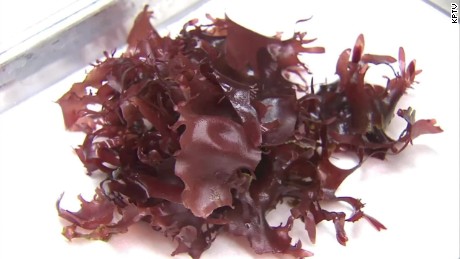
Seaweed Bacon
Vegetarians and health fanatics around the world can rejoice to the familiar taste of bacon. Biologists in Oregon have created a strain of dulse seaweed that tastes like bacon once it is cooked. The red sea plant is a vitamin-rich super-food, and had twice the nutritional value than that of kale. With 16% of protein in dry weight and the various ways of preparing it, the super-food can potentially be a substantial nutritious substitution for the fatty and cholesterol-rich bacon. Many chefs in Portland, Oregon are testing the super-food in their recipes for both cooked and raw consumption. Although, full analysis on whether or not a commercial operation would be economically practical has yet to be pursued. Dulse can be grown quickly and in large quantities, which makes it very desirable. In fact, the biologists in Oregon are growing the plant in large tanks at about 20-30 pounds per week. They plan to increase production to 100 pounds per week. Further research is being conducted on the bacon flavored dulse to gain further knowledge of its chemical properties and potential uses. Since the plant grows in water, all that is need to produce the crop is seawater and sunshine. This makes it a somewhat cheap crop to produce and sell. I found this article interesting because, even though I love bacon, I rarely eat it because of its small nutritional value. The discovery of this "healthy bacon" is very appealing to me and I think other people would feel the same way.
![]() |
| Dulse Seaweed |
Saturday, August 8, 2015
Dolphin Exploring Unfamiliar Habitat
A dolphin has recently found its way into the South River
located in Old Bridge New Jersey. The Marine Mammal Stranding Center were
focused on finding ways to usher the mammal back towards the deeper waters in
order for it to make its way back to the ocean. However, the dolphin choose to
stay in the river for another day, which forced the Raritan Riverkeeper group
to ascend into the water to help lead it back towards the ocean. The mammal
chose to stay in the new ecosystem it had ventured into despite the efforts.
This river being fresh water is not the proper location for
the dolphin to be settling. The mammal was not eating and was a senior, making
it extremely deteriorating towards its health. According to Robert Schoelkopf
the director of MMSC the river was not a safe area for technicians to advance
in to with its slopping sides and deep center. The experts are doing all they
can to direct the dolphin back to the open oceans and save its life.
As an intern at the Marine Mammal Stranding Center I have
had a close relation to this happening. It is very uncommon for dolphins to
enter fresh water areas and stay for long, which suggests it might have been
looking for food because of the decreasing amounts of food sources in the ocean
due to over fishing. If dolphins are not able to get necessary nutrients in the
ocean maybe they are going to more frequently start invading other bodies of
water, which could result in evolution for these mammals.
Friday, August 7, 2015
Are Kangaroos Left-Handed?
The kangaroo, a marsupial species, is thought to exhibit left handed favorability. Researchers in Australia have studied two bipedal species of kangaroos and one bipedal species of a wallaby. The study showed that the two kangaroo species favor their left hand in all activities, whereas the wallaby favors the left hand in activities such as feeding. However, quadruped marsupials are known to have relatively weak forearms and do not exhibit hand favorability.
This new information is strange because true 'handedness' was thought to have evolved from primates and eventually humans. This shows that there is a connection in the evolution of the kangaroo and other handedness species. Although, most handedness mammals are right handed, rather than left handed. I found this study interesting because it shows more information on the kangaroo and their behavior. I always thought they were a strange species, because of their habits and characteristics. This new insight adds to my previous perspective of the strange, but unique species.
![]() |
| Red Kangaroo in Australia |
Labels:
Australia,
bipedal,
evolution,
kangaroo,
left handed
Monkey Mud Pies
Vernon Reynolds is a professor at Oxford University for
emeritus biological anthropology. He has been studying the lives of chimpanzees
in the Budongo Forest in Uganda for over 50 years and for the first time has
experienced something that he has never seen these animals do before. The
chimps have begun eating clay as meals. Dr. Reynolds theory on the chimps
interesting new food choice is brought on by the mass deforestation of raffiapalm trees. These trees leaves can be used for tobacco needs and the tobacco
farmers have been removing them in mass amount to cure and dry tobacco. The
chimps usually would eat the decayed pith of the raffia tree, which is abundant
in necessary minerals but with the deforestation of this tree it seems they
have turned to clay to receive their necessary minerals.
Dr. Reynolds has stated that the clay has ““plenty of aluminum in it, high concentrations
of iron, lots of manganese, magnesium and potassium,” which is very efficient
for a chimps diet. The one down fall is the lack of sodium levels in the clay.
The raffia palm trees provided a great amount of sodium to the chimps in the
past that the clay does not. There is no known source of sodium that the
chimpanzees are acquiring in order to make up for the lack of it they receive
from the clay.
This is
a great representation of evolution, when a key resource is diminished these
chimpanzees have made sure to find a new source to take its place. Eating clay
may not be as tasty as raffia trees but the chimpanzees are not giving up their
territory that easy and are making do with what they have.
Labels:
chimpanzees,
clay,
monkeys,
raffia trees,
tobacco,
Uganda
Yet Another Consequence of Noise Pollution
Noise pollution has been an underlying factor in our lives for years. It’s a product of transportation, technology,
and mechanical interactions with the environment. We’ve grown accustomed to its constant din,
and as a result, tend to hardly notice the impact it has on our local and
environments. Researchers have turned
their attention to a northwestern region of Australia, an area that is active
in its use of oil and coastal construction; an area that is home to more than a
hundred species of sharks and rays.
Previous investigations have found that anthropogenic noise can destroy
sensory tissues in the inner ear and lateral line systems of fish, which can cause
loss of hearing or the ability to detect hydrodynamic changes, which
consequently may lead to death. Noise
pollution does not only bring physical harm to the sharks and rays, but may
mask communication among species or the sound of local prey or predators.
Sharks
are sensitive to the low frequencies that overlap with human-made noise, and
though many sharks are itinerant, most sharks in the northwestern region are
nonmigratory species. As a result, they
will most likely remain in the same area, even in a particularly unfavorable environment. The Neuroecology Group of the UWA Oceans Institute
and School of Animal Biology is conducting research to determine the reactions
of sharks to the several noise frequencies.
This research is important in discovering the extent of the effects of anthropogenic
noise on sharks. With this information,
they can raise awareness of the issue, and hopefully take action to nullify it.
Labels:
animal behavior,
Australia,
frequencies,
hearing,
noise pollution,
sharks
Subscribe to:
Posts (Atom)