Tuesday, December 7, 2010

New study finds that low doses of aspirin also may reduce Cancer deaths.


Found on ScienceDaily.com, An Oxford University Study finds that a daily low dose of aspirin may now also prevent cancer deaths. The study showed that cancer deaths dropped about 20%. As commonly known aspirin is usually taken to reduce heart disease, with a small risk of stomach bleeds.
"It took about 5 years to see a benefit in taking aspirin for oesophagus, pancreatic, brain, and lung cancer; about 10 years for stomach and bowel cancer; and about 15 years for prostate cancer. The 20-year risk of death was reduced by about 10% for prostate cancer, 30% for lung cancer, 40% for bowel cancer and 60% for oesophagus cancer." (quoted from the article on ScienceDaily.com)
The article also mentions that these findings do not mean everyone should now take aspirin. Because we ultimately do not know how aspirin can effect someone in 30 or more years. But the benefits of aspirin are extremely positive which outweighs the small risks of taking it.
I think its a really great find. Something so simple people already take for heart disease could also help reduce cancer. But I also agree with the warning that we don't really know the effects it could have on someone 30 years down the road. So even though its good news, its still not the ultimate medicine that will help prevent cancer.

Monday, December 6, 2010

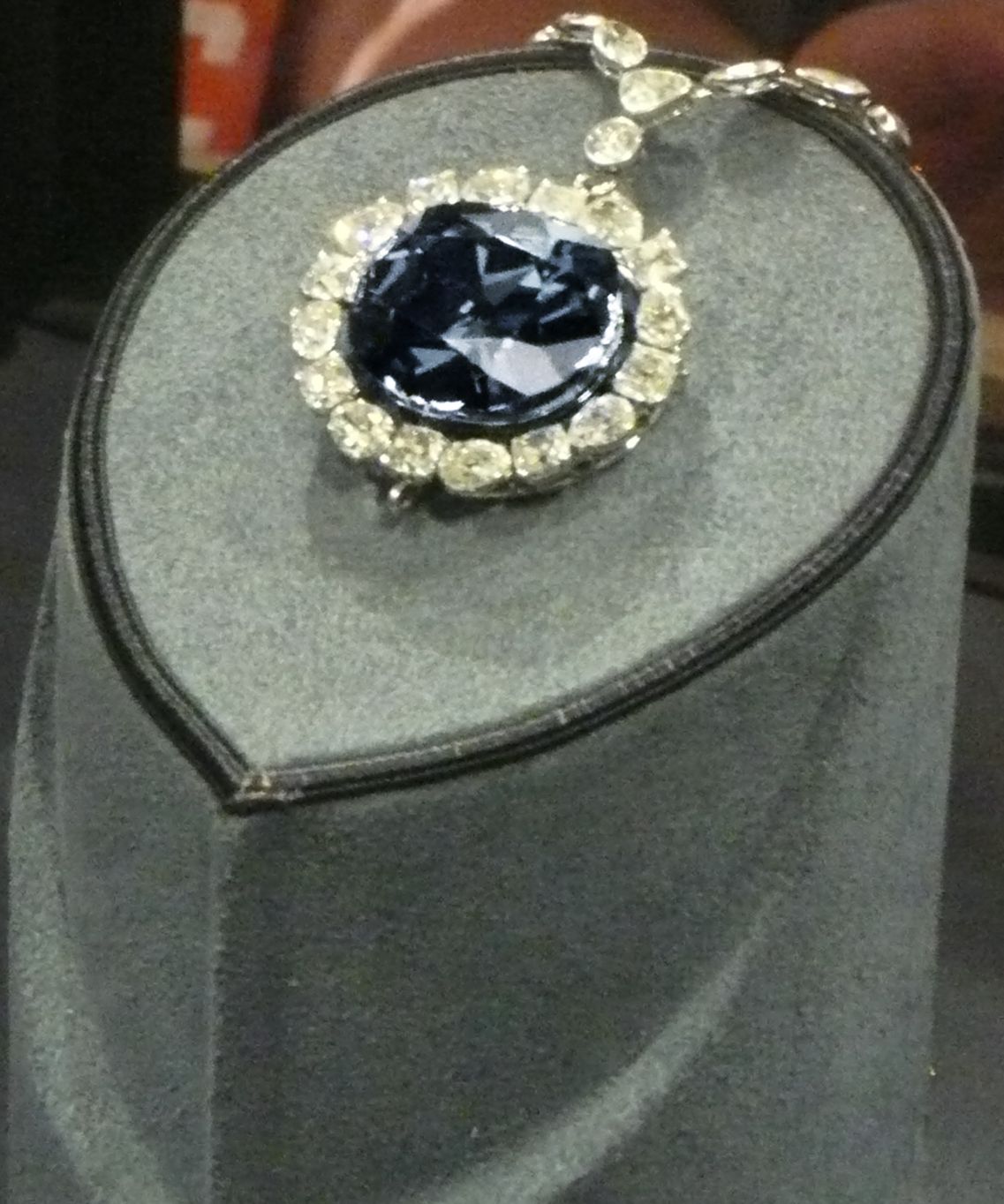
Why the Hope Diamond is So Blue

According to an article in the Smithsonian, the Hope Diamond was taken from the National Museum of Natural History's gem hall for an overnight stay in the mineralogy lab. Geologists held an experiment to figure out why the Hope Diamond is so blue. The deep ocean blue color is rare in diamonds, occurring in only one out of several hundred thousand diamonds. The Hope is 45.52 carats, and is the largest known deep blue diamond. On November 21st, 2010 there was a documentary about the Hope Diamond on the Smithsonian channel which showed parts of this experiment. Geologists know that the main "ingredient" that makes the Hope Diamond so blue is boron. After many hours of experimenting, the results read that boron, carbon, hydrogen and possibly some nitrogen were present. According to the article it will be months before scientists can publish full results from the experiment.
I think it's really interesting the things that scientists can do. Just by putting a diamond into a machine they can figure out what elements made up the Hope Diamond. I also find it interesting that they are allowed to "borrow" something so rare and worth so much money. I wasn't aware that the Hope Diamond was the largest known deep blue diamond. If I got the Smithsonian channel I may have considered watching the documentary because this is a very interesting experiment in my opinion.

Painkiller Ziconotide Could Increase Suicidal Ideation

According to ScienceDaily.com the painkiller Ziconotide could increase suicidal ideation. 6 years ago it was confirmed a safe alternative to morphine. But now it is under the suspicion that it could cause some to commit suicide.
Its ideal target is to reduce pain, but there is suspicion is can also reduce anxiety and impulse control, and change the frame of mind. This is not in all patients, but more likely those with a history of depression or are prone to depression.
Ziconotide was created so that it would not have any of the side effects like opioids, such as respiratory depression.


There isn't much to the article itself, so it was a little hard to write. But I think its a really important article. I can only assume that screenings for depression would now soon be required (or strongly recommended) before someone is given this painkiller. But of course it is only a suspicion and hopefully more research can help the problem.

Sunday, December 5, 2010

Newfound planet stirs old debate

Astronomers who have spotted three large planets orbiting around a single star have just found another one, that seems to be larger than Jupiter. It seems to be very close to the star HR 8799. The astronomers are wondering how all four planets were formed. The newly-found planet lies only 130 light-years from the Earth, and 14.5 astronomical units from its sun. "The planets orbiting HR 8799, with masses estimated at between five and 10 times that of Jupiter, form a scaled-up version of the planets in the outer solar system, according to codiscoverer Christian Marois of the Herzberg Institute of Astrophysics in Victoria, Canada, and his colleagues."

The astronomers are also wondering how the gas giant arised. The astronomers believe that if the other three planets were formed right where they are they must have been formed by gravitational instability, and the new planet is believe to be formed by core accretion. There is also a belief that the planets have migrated after they were formed. They are still discussing this issue, and are hoping to find out how these planets were formed.

I found this very interesting. Especially how new planets are continuously found in space. It makes me wonder how many more are out there that have not been found yet, and how many are forming at this very moment.

How Many Stars? Three Times as Many as We Thought, Report Says


According to the New York Times article How Many Stars? Three Time as Many as We Thought, Report Says, by Kenneth Clang, we may have underestimated by three times the amount. Scientists believe that by under counting the dim dwarf stars in certain galaxies astronomers may have a false understanding on how galaxies form and grow over the eons.


The problem is that astronomers cannot actually count the dwarf stars, which have masses less than a third on the Sun, in the galaxies outside the Milky Way. So alternatively they counted the brighter sun-like stars and assumed that there were about 100 unseen dwarf for each of the larger sun-like stars, since that is how the Milky Way is.


Researchers do not think every galaxy is like the Milky way. Dr. van Dokkum and Dr. Conroy used a new technique to establish the number of dwarf stars in elliptical galaxies. Dwarf stars are cooler so the fingerprint of certain colors they emit and absorb is different from that of larger stars. So without actually seeing individual stars astronomers could calculate the number of dwarf stars required to produce the telltale color fingerprint they detected in the light coming from the whole galaxy. Their finding showed that in eight elliptical galaxies the ratio of dwarf stars to sun-like was 1,000 or 2,000 to 1 opposed to 100 to 1 in the Milky Way.


"We may have to abandon this notion of using the Milky Way as a template for the rest of the universe," Dr. van Dokkum said. If the findings are correct, an undercount of dwarfs would mean astronomers have underestimated the masses of galaxies, and that would mean that galaxies developed earlier and faster than currently thought.


Although these findings seem astonishing, many are skeptical. For one, the research assumes that the stars in an elliptical galaxy are made of exactly the same stuff as those in spiral galaxies, which is an assumption that cannot be tested yet.


So for now, I think further information is needed to believe these findings.

Friday, December 3, 2010

Microbe that can use arsenic as nutrient found

Science may have found new forms of life on Earth and beyond. Strange bacteria that can use arsenic as one of its nutrients widens the scope. Scientists are studying this new bacteria and it shows that it has life beyond. One scientists stated, "This organism has dual capability. It can grow with either phosphorous or arsenic. That makes it very peculiar, though it falls short of being some form of truly 'alien' life," commented Paul C. W. Davies of Arizona State University, a co-author of the report appearing in Thursday's online edition of the journal Science. This makes me wonder what could possibly be out there. It is such a mystery how science finds something new each day

Thursday, December 2, 2010

Arsenic and Old Bacteria


It is common knowledge that the element arsenic can be very deadly to most living life forms. Surprisingly, there have been new studies that show that arsenic can actually help certain bacterium survive, and in some cases, reproduce.
According to Biology News Net, research began on this subject when Mono Lake in California was examined closer. The lake has high levels of dissolved arsenic concentrations, and it is believed to have been formed from neighboring volcanic eruptions. The study done by Lawrence Liverpool National Laboratory, which was led by NASA, found that a bacterium isolated from Mono Lake can substitute phosphorus with arsenic to sustain its growth.
The six building blocks of living matter are oxygen, carbon, hydrogen, nitrogen, sulfur, and phosphorus, which are all made up of nucleic acids, proteins, and lipids. These new studies show it is possible to replace one of the building blocks of life with something that is considered a poison. That shows that it is possible for organisms to live and survive on non-typical elements, so scientists have used this idea for the subject of life on other planets.
I thought this article was very interesting and thought provoking. If it is possible for bacteria to live off of this dangerous element, who’s to say that there aren’t other life forms who can live out in space on those uncommon elements.